
RD: 'Many parents have no idea what is happening to their daughter'
Photograph: Reformatorisch Dagblad
Interview with the feminist Sybilla Claus, by Tineke van der Waal
Reformatorisch Dagblad, 18 October 2024
________________
"Online, girls are being pushed into accepting a narrowed image of womanhood," observes former Trouw journalist Sybilla Claus. In her book Gender Rebels she pushes back against the modern straitjacket for girls. The feminist is deeply concerned about the girls of Generation Z, the Zoomers, who have grown up with the internet.
Sybilla Claus (65) dedicated herself in the seventies and eighties to the position of her sex. She fought for freedom, opportunities and rights for women. But when she looks at the girls and young women of today, she is seriously worried. "Girls today are under enormous pressure and not in good mental shape. Many teenage girls feel permanently sad or depressed. The Netherlands is a prosperous and pleasant country to live in, and yet the mental health of girls keeps deteriorating. The proportion of Generation Z girls and young women in the Netherlands who self-harm continues to rise."
Photo: Jörgen Caris, Trouw
What is the first thing you notice when you look at girls?
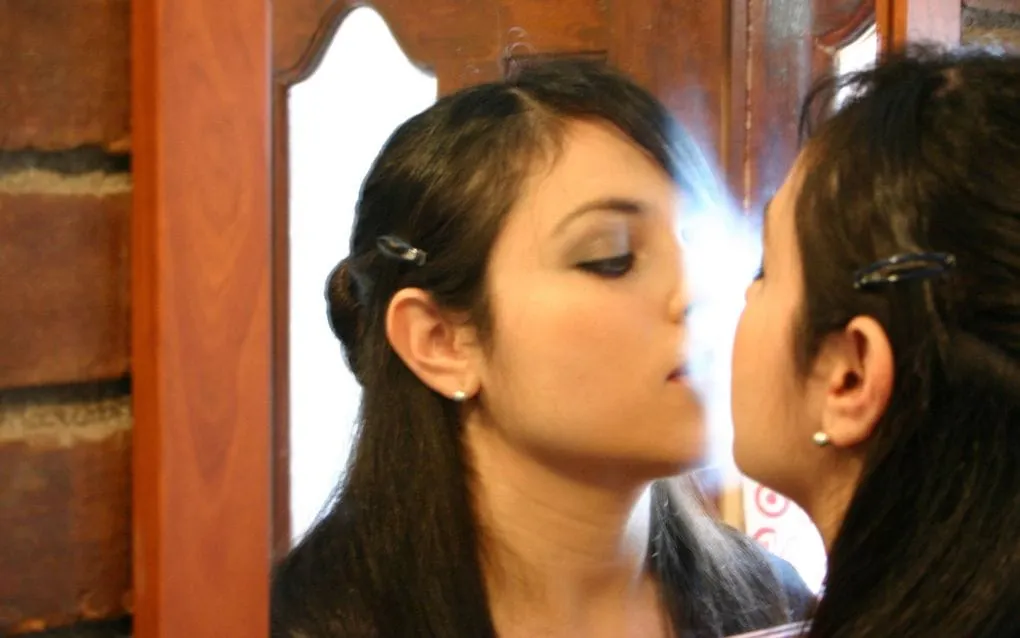
"I am shocked by how uniform girls and young women have become and how preoccupied they are with their appearance. There are make-up tutorials for eight- and nine-year-olds. Girls learn online how to pose: head tilted, duckface, one leg bent. And certainly not with their hands on their hips and their face straight to camera, which is what powerful women of my generation love. Times have changed beyond recognition, but many parents have no idea what is happening to their daughter."
How do you explain that?
"Smartphones, fast internet and online platforms are the biggest problem. Their pull is enormous. Girls are apparently on their phones for an average of six hours a day or more. Teenagers, by their nature, have no brakes, which is why it is unwise of parents and schools not to set limits. The more hours they spend online, the less time there is for books, friends, hobbies and exercise. And there is more physical damage too — to the eyes and the brain, for instance. But the inner effect is the worst, I think: the mobile phone pulls young people away from themselves."
The messages girls receive online put them under pressure, you write.
"Online, girls are pushed into accepting a narrowed image of womanhood, and in the process they hold one another in a stranglehold. Where have all the varieties and forms femininity could take at the end of the last century gone? In our day we fought for a freer individual, but by now the roles have once again become very narrow. The impossible demands of a socially prescribed perfectionism loom large in girls' minds."
An important part of your book deals with gender confusion in girls.
"You can see that a small but growing group of girls feels unhappy with the new, narrow, stereotypical role for women and wants to escape it. Now that gender ideology is everywhere, they start to ask themselves whether they might be a boy or non-binary. They want to flee from being a woman. That is alarming, because you cannot change sex; nobody can escape their biological sex. You can see how hard girls and women who transition have to work at living a masculine life. On online platforms they ask questions all the time: isn't my voice too high? Am I laughing too much? How should I hold my hands in a masculine way when I talk? That is their new mould. We have become extremely focused on appearance and form, and less on substance. That is a great loss."
In your view, what is the significance of a ban on conversion therapy, which the House of Representatives is about to debate?
"In the Netherlands, this far-reaching bill is barely discussed. Many media outlets keep information about it from their audience, so the ignorance continues. The bill seeks to outlaw conversion therapy: attempts to suppress homosexual feelings or gender identity. It is appalling that the law — without informing the Dutch public — also seeks to ban therapy for teenagers with gender dysphoria, even though child psychiatrists agree that therapeutic treatment should always come before irreversible physical interventions. The drafters therefore want to deny doubting teenagers this life-saving treatment. The bill states that therapists may only affirm a gender identity and must therefore rely on a patient's subjective feelings — on pain of being struck off, a fine of 22,500 euros and a prison sentence of up to a year. It is unprecedented for a democracy to threaten therapists in this way. Teenagers often cannot foresee the consequences of their actions because their identity has not yet developed. A confused child has the right to honest help from a therapist who is willing to ask critical questions."
This is where feminists and orthodox Christians meet.
"I love that. A number of Christians have their say in my book as well. We recognise one another in the resistance to an ideology that ignores science and biological reality and lets children become entangled in this way of thinking."
Feminism has, however, also served as a stepping stone for gender ideology.
"I have to admit that. We wanted to erase every difference between women and men. I can now see, more clearly than in my student days, that biological differences matter. Thanks in part to research, we now know better that the brain, the genes and biology in general play an important role, and that there is something beautiful about the differences between the sexes."
________________
Would you like to read the original article?
Reformatorisch Dagblad: 'Feminist Sybilla Claus: many parents have no idea what is happening to their daughter.'
Sybilla Claus
Anthropologist, journalist and author. Author of Gender Rebels (2024) and the upcoming Rebel Girls (Spinifex, 2026).
Published by Uitgeverij 't Haantje · © Sybilla Claus